Is Computer Science Still Worth It? Let's Talk Real Talk
Hey, I'm Prasenjit. A lot of people keep asking me some version of this: is computer science packed and done?
When I first wrote this post in 2024, my answer was basically "nope, go for it!" I still think CS is worth it. But the market got harder since then, especially for freshers, and I'd rather give you the honest version with real numbers than a pep talk. So this post covers what the data says (both the good and the bad), what AI actually changed, and what I'd do if I were starting today.

Short Answer: Yes, But the Easy Era Is Over
CS is not saturated. There's still a huge amount of work that needs people who can build and fix software.
What's gone is the phase where finishing a degree and knowing a bit of React was enough to get hired. Entry-level is crowded now. The people getting through are the ones who can show proof they can build things.
Both of these are true at the same time, and the numbers show it.
The Good News in the Numbers
The US Bureau of Labor Statistics projects that software developer jobs will grow about 16% from 2024 to 2034 (15.8% to be exact). That's around 267,700 new jobs, and way faster than the roughly 3% average across all occupations.
They also expect around 129,200 openings a year for software developers, QA analysts and testers combined, many of them from people retiring or switching careers.
And CS still pays well early on. New York Fed data puts the median early-career wage for CS grads at $87,000, versus $58,000 across all majors.
The Bad News in the Numbers
Now the part the "just learn to code" crowd skips.
The same New York Fed data (2024 census numbers, published in February 2026) shows that recent CS grads, ages 22 to 27, had 7.0% unemployment. Computer engineering was 7.8%. The average across all majors was 4.2%.
So right now, fresh CS grads in the US have a harder time finding a first job than the average graduate. A few years earlier, CS was one of the safest majors on that list.
One detail I find interesting: CS grads who do get jobs are much less likely to be stuck in jobs that don't need a degree (about 19% "underemployed" versus 39% across all majors). So it's hard to get in, but once you're in, the work is usually real CS work.
Quick honesty note: these are US numbers, because that's where the cleanest public data is. I couldn't find equally solid public data for India, so treat them as a signal, not a law.
What Changed?
A few things hit at once:
- Hiring cooled after the 2021 boom. Lots of companies over-hired, then cut back.
- More people studying CS. More grads chasing the same entry-level roles.
- AI tools changed junior work. A lot of the simple tasks juniors used to learn on, like boilerplate, basic CRUD pages and small bug fixes, now get done faster with AI. I wrote about how I use it in this post.
That last point is the one people panic about. But notice what AI didn't replace: someone still has to understand the problem, decide what to build, review what the AI produced, and fix it when it breaks. That's the job now, even for juniors.
Let's Bust Some Myths
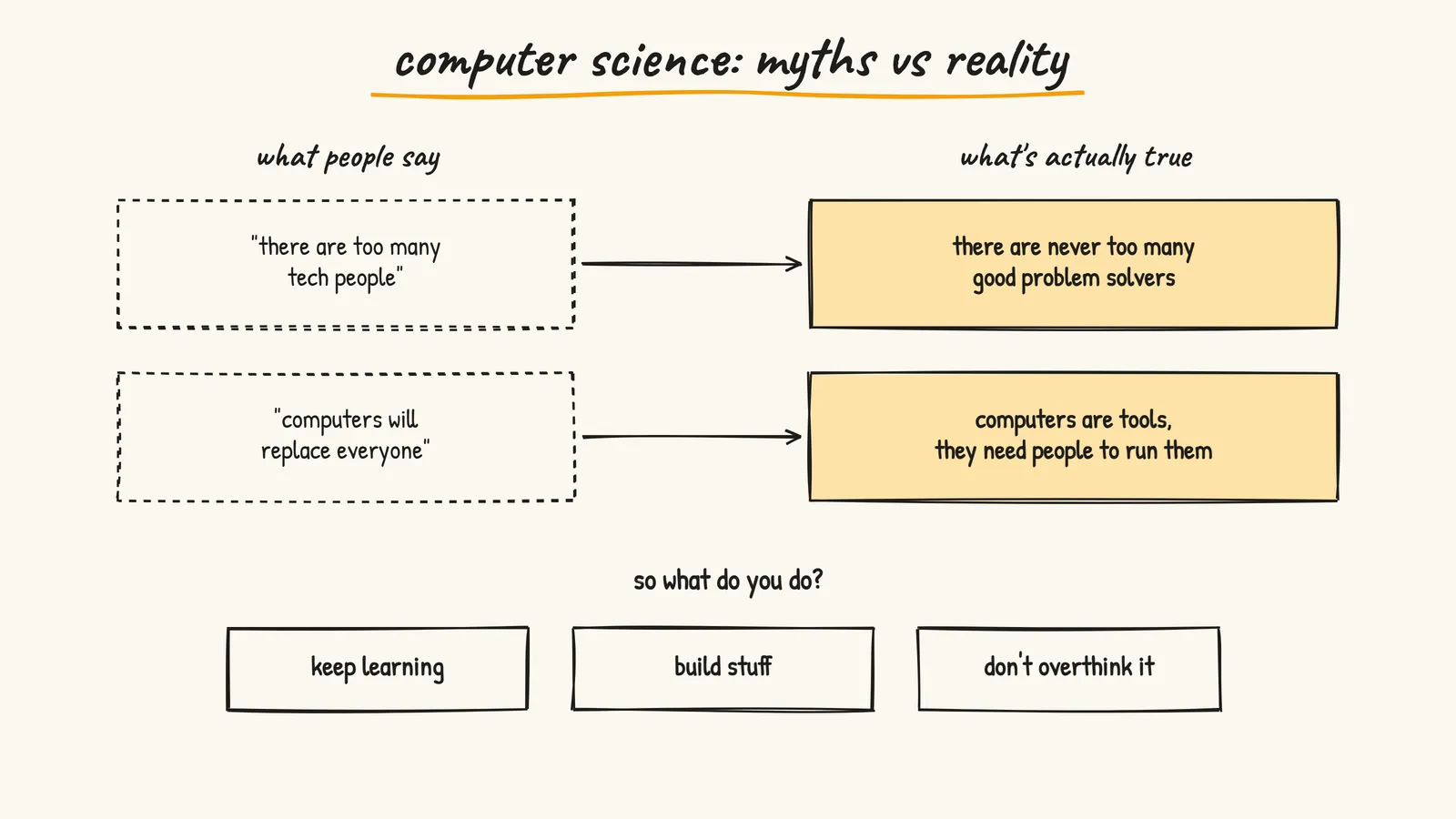
Myth: Too Many Tech People
Reality: There are too many people with the same generic resume. There are not too many people who can actually solve problems and show it. Some of the "it's saturated, don't bother" talk honestly sounds like people who'd prefer less competition.
Myth: Computers Will Replace Everyone
Reality: Computers, and AI, are tools. They need people who understand what they're building and can tell when the output is wrong. That's where you come in.
Here's the short version of both myths:
What Actually Gets You Hired Now
If the degree alone isn't enough, what is? From what I've seen, it comes down to proof.
- Projects that solve something real. Not another to-do app. Something a real person could use, deployed, with a link.
- Shipping in public. A GitHub with real commits, a short write-up of what you built and what broke. It shows how you think.
- Fundamentals. Data structures, how the web works, databases, reading other people's code. AI makes these more important, not less, because you have to judge its output.
- Using AI well. Knowing how to get good code out of AI tools, and when not to trust it, is now a normal skill employers expect.
- One area you go deep on. Frontend, backend, mobile, data, security. Being "pretty good at everything" is exactly the generic resume that gets lost.
What Should You Do?
If you're in college or about to start:
- Do the degree properly. Don't skip the fundamentals because a YouTube video said DSA doesn't matter
- Build one real project per semester and actually deploy it
- Use AI tools daily, but make sure you can explain every line you ship
- Write about what you build. A short post or thread per project is enough
- Pick a direction by your final year and go deeper there
- Apply wide and early. The first job is the hardest one. Internships, freelance gigs and open source all count
If you're already out and struggling to land a first job: keep building and keep shipping. A good project with a live link beats ten certificates.
The Real Deal
Computer science isn't saturated. It's just not easy mode anymore. The long-term demand is real, the pay is still good, and the work is still exciting. But the entry is harder than it was, and "I have a degree" isn't a differentiator.
So is it still worth it? If you actually like building things and you're willing to show your work, yes. Start now, start small, but start.
Resources
- BLS: Software Developers outlook - Job growth, openings and pay projections
- New York Fed: Labor Market for Recent College Graduates - Unemployment and wages by major
- My AI workflow post - How I actually use AI as a developer
Your tech buddy, Prasenjit